Freitag, 16. August 2019

Dassa-Zoumé, Benin

2019-08-09/10: The 41 hills of Dassa and the wonderfull Armands Ecofarm.

Armand's and Johanna's Ecoferme Maktub:


The entrance gate of the farm.
 
This eco - farm is a small green paradise.

Gandalf at the Maktub farm in Dassa-Zoumé.
 
Armand, the owner, has a master's degree in Natural Sciences from the University of Cotonou but his dream has always been to have a farm. After his studies, an importand land owner of his hometown, Cové, gave him 20 ha of forest to exploit. This was a hardnut to crack and he had to give up after 3 years of hardship.

At that time he had an offer of teaching post in Dassa which he accepted to restore his financial health. As soon as he arrived he knew that this was where he would settle. He immediately fall in love with the region.

His next project has been well thought out. A farm, yes! but on a family scale. And that's how he started his ecological farm here in the year 2000. They had to work a lot, he and his wife, Johanna. Today they have employees to assist them. The 6 mango trees for example are so fruitful that they produce some 1000 jars of jam each year. As for the papayas, the harvest is such that they cannot transform it all into jam, although they produce around 1600 jars per year.
In addition to this small hectare they have a plot by the river a little further where during the rainy season they grow rice. They also entrust part of their livestock to a local farmer to take care of it.

Johanna and Armand the owners of the Ecofarm.
The large central part of the lodge is made up of thatched huts, a large one in the middle that serves as a restaurant and two or three others around it, smaller, for relaxing.

The large central hut.

Christine relaxes under a straw hut on the farm.
Two or three bungalows positioned on the outskirts complete the tourist accommodation part of the farm.

The bungalows

Maktub Farm, private outbuildings.
The rest of the land is dedicated to the farm and private homes of Armand and Johanna.
The land is not quite 1 ha and Armand and his team grow a little bit of everything there in small quantities. Similarly, the various enclosures for breeding remain on a family scale (goats, sheep, ducks, guinea fowl, hens, etc.). It’s Armand’s motto, his small business must remain on a human scale, just enough to support a family,


Delicious diner with friends

Hike to the 41 hills of Dassa on 2019-08-09.

We are not alone at the farm. Five young people have just arrived with whom we sympathize immediately. Two French young men, one French girl and two German girls.
It is with them that we will undertake our hike in the 41 hills of Dassa.
We are talking about the 41 hills of Dassa. In fact they are much more numerous but the number 41 has a religious value in Dahomey and it is found in many rites throughout the kingdom. In Fon culture, the country's main ethnic group, the earth was considered to be one of the 41 children of God.

Armand is organizing a guide and some zems (the famous motorbikes in Benin) for tomorrow 9:00 am.The zems are on time. The guide will cost us 2,000 CFA (3.14 €) per person, we must add 1,000 CFA per head for the zems, which is ridiculously cheap for 15 km and just over 3 hours time.

We understood that we were going for a hike to "Prince's hill" in Dassa. I am somewhat surprised to learn from our guide that we are actually going to the "wells hill" above the village of Awaya some 6 km in the opposite direction.

We each get on our motorbike, I have the honor of riding behind our guide, Noé. We join the main track which suffered a lot from the heavy rains at night. We are twice obliged to dismount to pass two large streams of rainwater. One of them is partially blocked by a car that got stuck in trying to get past it.
The track is flooded by the night rains.

It takes us half an hour to reach the village of Awaya and the start of the hike. The drivers store their motorcycles under a covered courtyard in the village where they will be waiting for us. One of them accompanies us during the hike in addition to our guide, of course.

We start with a flat stretch, first through a small wood of teak and tall grass which turns out to be mint and from which Noé praise us the anti-mosquito properties. Nice, but I would still not give them my anti-malaria protection! Then along fields of cotton and corn. We already know the plants and trees that Noé presents to us: cassava, african locust beans, baobabs, cashew trees, neems…. etc.

First part of the hike, very wet.


The two girls are in shorts, Johanna even wears sandals. It’s not really the perfect equipment for walking in the bush! I even regret not having put my real hiking shoes instead of the lighter fabric ones, because the ground is completely soaked with water.
After 1.3 km of flat path we arrive at the foot of a huge granite monolith, the "hill of wells" which we will begin to climb. A very delicate climb at some places because the humidity makes the rock extremely slippery. Christine will even pay a small part of toboggan on the buttocks. For the most critical section I prefer to take off my shoes, the grip being much better barefoot. The few children of the village who accompany us barefoot and the zem driver in sandals do not have these problems and climb like goats!
The rock is wet and it slides a lot!


Once at the top we understand why this block of granite is called "hill of wells". Natural bowls dug in the granite hold rainwater, some never dry completely, even in the dry season. In the old days people from the village came here to get water. This seems rather unimaginable. Climbing every day to the top of this 90-meter-high block of granite and coming down from it with dozens of liters of water must have been quite a chore. Today, boreholes have been dug at the village level and villagers no longer have to climb on the monolith to get their supplies.

At the top of the monolith: the wells!


We spend a long time at the top admiring the panoramic view towards Dassa and its hills to the west and the wide plain dotted with hills to the east towards Nigeria about fifty kilometers away.

Panorama of "the hills" from the summit.

View towards Dassa and its hills.

Rice fields.


The whole troop at the top: Delphine, one of the children, Florent, Johanna, Thierry, Christine and Rémy.

After half an hour break it is time to resume the way back. We descend from the monolith on a slightly less demanding path.
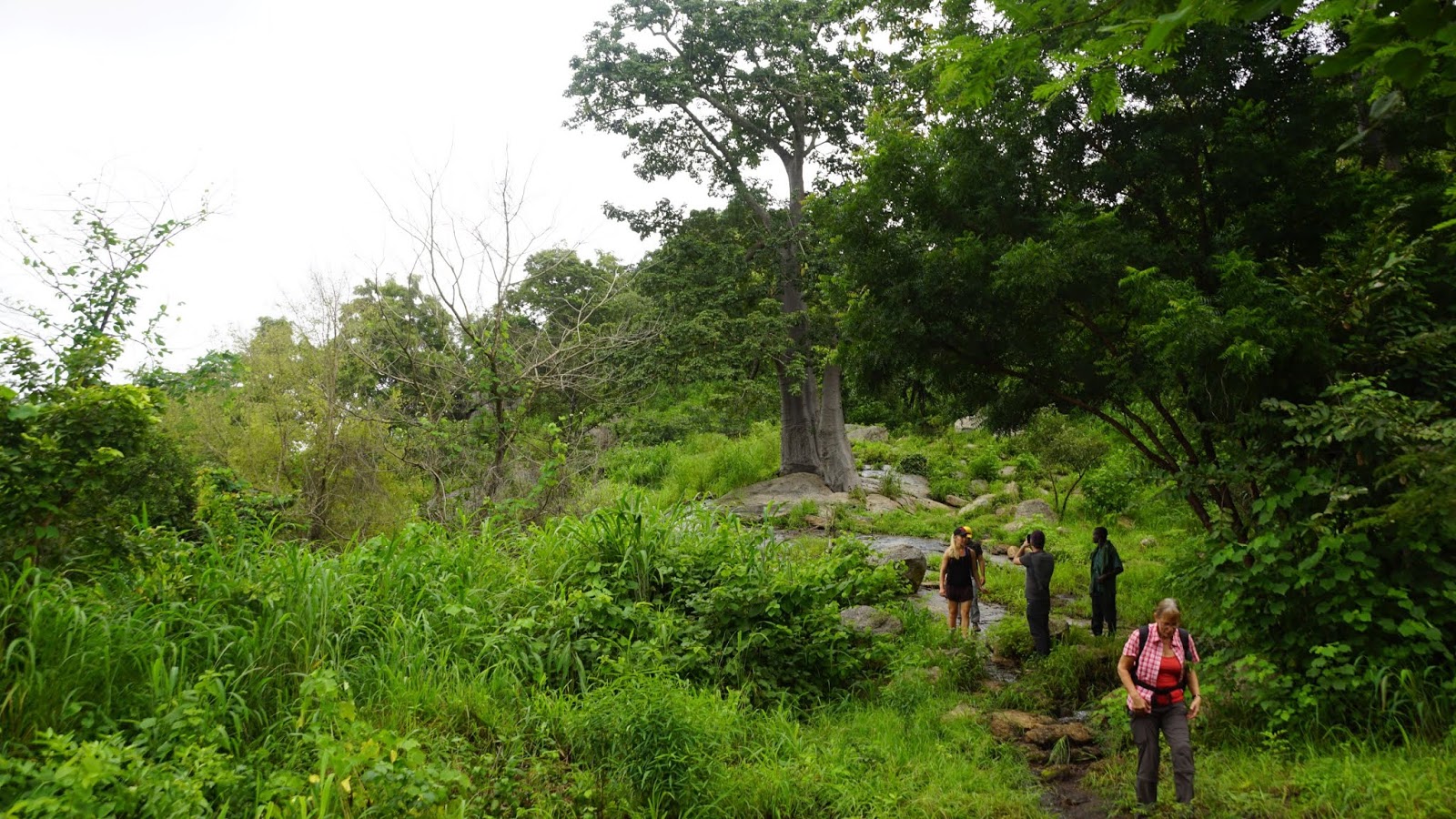
On the path back to the village.
At the village. The mango tree.
Once in the village we get back on our motorcycles to reach the farm. The effects of the rain have faded somewhat, the streams and ravines carry much less water and the motorcycles pass without us having to dismount.
Back on our zems.

We are back at the camp at 12:20 p.m. We pay Noé, 6,000 CFA (9.42 €) for both of us. He takes care of paying the zems.

Sonntag, 11. August 2019

Abomey, Benin.

2019-08-06/07 : Abomey, in the footsteps of the kingdom of Dahomey. Royal palaces and underground villages.


2019-08-06 : Visit of the Royal Palaces of Abomey.

Today our main focus is the Abomey Museum (Royal Palace), the main attraction in the city. It is 11:25 am when we ask two zemidjans in front of the porch of the hostel to take us there for 500 CFA each. It doesn't take ten minutes to get there.
Visiting the museum is free, but a small voluntary contribution is welcome and clearly expected.
In front of the Royal Palace of Abomey.

Photography in the palaces is prohibited. I wonder why.
I have to leave my photo bag in a small safe deposit box at the entrance. So I allowed myself to go snooping on the internet for the photos below.


We join a small group of a dozen Beninese tourists for the guided tour led by Jonas.
The site of the palaces of the kingdom of Abomey covers 48 ha, it has become a vast royal city in the space of 300 years, since the creation of the dynasty in the early 17th century, because unlike the tradition of the kingdom of Porto-Novo where the successive kings all lived in the same palace, here each of the kings had to build his own palace close to that of his predecessor. In all, 12 kings succeeded each other, so there were 12 palaces built. Built in earth, very few have survived over time, victims of rain and other weathering. Today only two of the last palaces remain, that of Ghézo (1818 - 1858) and that of his son Glélé (1858 - 1889). These are the two palaces that we will be able to visit this morning.
The visit is expertly led by Jonas, our guide, a graduate in history and archeology. In the beautifully renovated buildings are exposed all kinds of objects that belonged to successive kings. What we will remember from this visit is especially the particularly brutal and bloodthirsty aspect of the traditions and customs. Human offerings were common and all cults were very hungry for blood, preferably human one.
The kingdom of Dahomey was particularly hawkish because article number one of its "constitution" required that each king had to leave to his successor a kingdom larger than that which he had found when he took power. This is how this kingdom, originally small, became one of the greatest regional powers. One of the military peculiarities of Dahomey were the Amazons, particularly effective warrior women.
The kingdom was particularly enriched with the slave trade from the 17th century. Abomey did not have direct access to the sea and had to pay rights of way to cross the kingdoms of Allada and Ouidah. As these became more and more greedy, Abomey attacked them and took possession of them.

Thierry in a craft store in the Royal Palace of Abomey.

We take advantage of the canteen of a "mama" installed in the courtyard to regain some strength after the visit by ordering local dishes called wandzou, beans with fish and meat, all accompanied by a more or less spicy sauce. The price is ridiculous: 1000 CFA, a half baguette included!

We are regaining strength in the courtyard of the Palace.
 

The entrance door to the museum.
Frescoed wall representing the symbols of the different kings of Abomey in town.


2019-08-07 : Visit to the underground village of Agongointo-Zoungoudo close to Abomey.

In Abomey we met an adorable young family of artists: Arolando, Sonia and their two children Toto and Marie. They offered to take us by motorbike to the underground village of Agongointo-Zoungoudo today.

Toto, Arolando, Marie and Sonia

They are punctual and are accompanied by a second motorcycle (a zem) as agreed. We negotiate the zem at 3000 CFA (4.71 €), a trifle in consideration of the distance (2 x 15 km) and the time invested (between two and three hours). We are not talking about Arolando but I am determined to give him a little more to support his artistic projects.
Christine rides with Sonia and Marie on the zem while I board Arolando's motorbike with Toto. The trip takes half an hour.

On Arolando's motorbike

Christine, Sonia, Marie and the driver of the zem.


So we arrive at 11:30 am at the underground village of Agongointo-Zoungoudo. Entrance costs 2000 CFA per person plus 500 CFA for photography rights.

Christine and Denis, our guide
Denis will be our guide. The site where we are located covers 7 ha and includes 56 underground caves. But in reality, more than 1600 cellars have been discovered throughout the region of the Abomey plateau. These underground houses date from the 18th century but were not discovered until 1998 when the ground collapsed as a construction vehicle passed.
They would have served as refuges and hiding places for warriors of the time to protect themselves from attacks from neighboring kingdoms.

Underground refuge.


They are reached by vertical wells with notches in the walls as steps. They are generally provided with 3 cavities set back from the central well. An arrangement that kept noises and voices trapped inside the building.
The different houses were all independent of each other. No connection tunnel existed between them.
The guided tour follows a small path in dense, green vegetation. This vegetation protected the houses, not only by camouflaging the entrances and muffling the noises but above all by keeping animals and insects at bay and retaining rainwater. It was also this vegetation that air-conditioned the cavities in the earth where the hot and humid air would have been otherwise unbreathable as we will see by visiting the only house open to the public and which is not protected by vegetation .


On the way we stop at a sacred place, a voodoo altar at the foot of a venerable baobab tree. We have to take off our shoes to get close to it. The most impressive thing is not this altar but the battle waged by the baobab tree and a strangler fig tree which decided to attack it. It’s the first time we’ve encountered a baobab plagued by a strangler fig. In general, they choose more puny trees, although we could admire one at the botanical garden of Aburi in Ghana which had struck down a huge kapok tree. But a baobab is a different kettle of fish ! The baobab while magnifying bursts the roots of the fig tree which will reform a little wider. The outcome of the fight is very uncertain.


The altar at the foot of the baobab tree.
Strangler fig against baobab.

A little further on, in the center of a voodoo temple dedicated to an unknown deity is the access to the only house open to the public. Without anyone really knowing why it is forbidden to enter the temple dressed in red. We descend using a steel ladder but originally the inhabitants of the house simply used the notches cut in the walls of the well.


The house consists of three cavities arranged around the central well. There is also a cistern which collected runoff water.

Arolando and his family in the underground house.


We return by the same path to the reception. After taking a quick look at the souvenir stands we get back on our motorcycles to return to Abomey with a small technical stop to re-inflate the rear tire of Arolando’s motorcycle.

Toto, Arolando and Thierry.